Wednesday, February 23, 2011

Motorcycle Diaries Day 3:


7:00 am arrived much too early as it usually seems to.  I had only been sleeping for about 5.5 hours, after a long and tiring day.  Given the leisure to choose, I would probably have still been asleep, or at least serious about going back to sleep.  This day, however, I did not have that option available to me.  Even if I had been able to turn my back on my commitment to get up and attend to my bike, I don’t think that I would have been able to return to sleep considering the noise.  Out in the courtyard of the dingy guesthouse the television speakers were attempting to tear themselves apart, or perhaps burst forth from their plastic prison.  I suppose you could call the sound music, although the volume far exceeded the capabilities of the speakers and the resulting distortion rendered the strains of African Hip Hop distorted and broken.  My room still carried the slight but prevailing odor of sour rotten cabbage seeping from under the bathroom door, and despite the fan and early hour, the air was already beginning to warm.  I reached for my phone to check the time, sighing in recognition that my time for resting had ended, and placed a call to my friend from the night before to find him already up and waiting for my call.  Thus spurred onwards I got up and dressed hastily, wearing the same clothes as the previous two days of travel because, after all, it is just too much effort to unpack and repack. Besides why dirty fresh clothes when these are at hand?  Today I would finally reach my destination and there I will be able to shower and change.  In a way it was almost disappointing to know that I only had approximately 35km to travel that day in order to finish my southern trek through Tanzania.  On the other hand it was nice to be able to look forward to a very short day of travel and a long day of relaxing.  
First, however, there was a flat tire to be attended to, something I hoped would be a relatively quick and easy procedure.  Once I was dressed and my teeth hastily brushed, with water from a water bottle, I left my room and headed out into the courtyard.  The music went from annoying to just plain ridiculous in volume, making me shake my head in a mix of incredulous humor and annoyance.  The street outside was just beginning to fill with people going to and fro, setting up market stalls, and carting goods.  My bike was just down the way, still stuffed and shoelaced into the back of the Daladala from the night before.  We unloaded the poor girl and pushed her down the street a little ways to an open patch of dirt populated by several young men, a few bicycles and several cows; apparently the local ‘garage.’  Now that it was light out it did not take too long to discover the cause of my tires catastrophic loss in air pressure.  A small roughshod nail was firmly embedded between the treads, having been somehow picked up during the previous nights ride.  I still have the nail, saved as a souvenir of the trip, and a reminder of how even very small and innocuous things can have profound effect.  


P1260052

P1260055


In relatively short order the back tire was off my bike and the tube being removed.  Watching the Fundi work with a few screwdrivers on a patch of dirt next to a cow paddy, I was again reminded just how easy these bikes are to work on, and how few tools are required.  All these learning’s were being filed away for future use, particularly in relation to my goal of eventually taking a 6 or so month trek through Asia and India by bike.  
My dream for this trip had originated while watching a special episode of one of Britain’s greatest television exports, Top Gear.  In this particular episode the hosts are dropped in Ho Chi Min City in southern Vietnam and tasked with traveling to the north of the country, 1000 miles, in only 8 days and with the equivalent of $1000 purchase transportation. This leads them to purchase cheap local motorbikes and set out through some of the most beautiful landscapes in the world.  I won’t ruin the episode for you if you haven’t seen it, though if you have not I highly recommend you take an hour, track it down on Youtube or a Torrent and watch it, but suffice to say the adventure they have is humorous and epic.  Watching that episode I started dreaming. It started small, just thinking of recreating that same trip, but anyone who knows me knows that I rarely dream small.  Soon the dream developed into a lengthy trek covering northern South East Asia, up into Mainland China, downwards passing through Nepal and Tibet, and finally descending through the length of India.  In many ways I considered my current trip through Tanzania as a trial run, a proving ground and educational exercise.  
Overall, thus far, my experience in Africa was actually very encouraging for my future goals.  Despite all the small mishaps and issues I had encountered I was encouraged by just how manageable each was.  I was particularly buoyed by just how few simple tools were required to address most of the ‘common’ problems I could expect to face.  For instance to repair a punctured tube:
Equipment Needed
    • 1 Wrench to remove back wheel
    • 2 Larger screwdrivers to unseat tire from rim
    • Small pliers to loosen nut on valve stem
    • Scrap rubber tubing
    • Contact cement
    • Bicycle pump to re-inflate 
Repairing my tire took about an hour total, and much of that can be attributed to the slow and relaxed pace that people here tend to work at.  I passed the time sitting on a bench, occasionally talking with the people there and repeatedly denying the request of a street kid for money.  This boy followed me everywhere I went and had his hand permanently held out in a beggar’s gesture.  
Despite being in Tanzania for the purpose of development leading to poverty alleviation I also had a strict no handouts policy.  That may seem contradictory or harsh but I have good reasons for it.  The first time I visited Africa, nearly a year earlier I did not come with such firm and formed ideals.  On the second day of that trip, however, I had a series of experiences that served to change my perspective and began to form a basis for my rationale.  We were taking an overnight train from Nairobi to Mombasa in Kenya.  When we got up in the morning we found ourselves rolling through the plains of East Africa, passing many small-unnamed villages, remarkable only by their poverty, and then only to our wealthy western eyes.  Every village we would pass would invariable spew forth a small troop of dirty and ill-dress children who would run to the side of tracks, hand outstretched and wearing seemingly forced smiles.  On seeing Mzungus on the train they would begin to yell,
“Mzungu, give me money.” Or “Please money.”
The sight of these dirty but insanely cute children begging on the side of the tracks was at first enduring and brought forth several small coins, candy and other trinkets tossed in their direction.  These were quickly snatched up and disappeared into pockets.  As we carried on though, and began to run out of things to offer we began to see the uglier side of our thoughtless actions.  As the train would roll past children and we would have nothing to give the reaction of the children was not amiable, it was not even dejected acceptance, as I would have expected.  Instead it was anger, the kind of anger which children display when they feel they are not getting something they deserve.  Suddenly I was hearing choruses of,
“Mzungu give me money,” promptly followed by, “Fuck you!” This from a 10-year-old child…
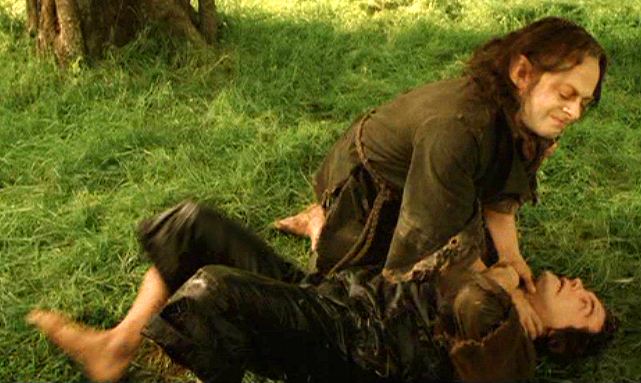
One of the last pieces of candy to be thrown sparked a vicious fight between two boys, which left one crying and the victor running away, his prize clutched close, in a scene, which reminded me of Smeagol and Deagol fighting over ‘The Precious.’  Other children stared with malevolence as we passed, as though their situation in life was our fault, or at least our inaction branded us as traitors to the system they believed in.  Mzungus meant free things, we meant handouts and charity, but there was not an enduring sense of gratitude towards our charity.  Instead there was an ugly expectant sense of entitlement, not something I am interested in perpetuating.  The problem with this kind of charity is that it leads to all manner of abuse and is not sustainable.  When we rich foreigners travel abroad, carelessly shedding money like dead skin, it has a highly detrimental effect in two major areas.  The first is that it skews the impression of local people as to how much money we have and our ability to give it.  This is why people are constantly trying to rip us off, coming and knocking on our gate asking us to sponsor them or just give them money straight up.  This is why it is so hard to explain to people that we are not able to help everyone, that our money has very real finite limits.  The second problem is that this can have a very detrimental effect on people working in development.  Good development works to help people empower themselves; to make them self-sufficient so that when we are gone they will continue to prosper.  Instead there is an expectation that we will just hand them the key to their future and they will not have to take responsibility for their own self-improvement.  While it is true that we have access to many things that they do not, and need in order to get ahead, such as capital and education, in the end it is only their hard work and perseverance which will allow them to rise above their current situation and stay there.  There is a very good reason why you see a lot more people begging in tourist centers.  I do not mean to suggest that aid and charity are inherently bad, and that they are the source of all begging and development struggles, but they often do not help the way that we intend them to.  
It is experiences such as these, which has led me to take a slightly harsher stand on the issue of giving out money.  I do not like being looked at like a cash dispensary and I have no wish to perpetuate a system that does not truly help the poor, and at the same time is creating systems by which foreigners are taken advantage of.  Nothing is ever as cut and dry as we would like and I have made some few exceptions, however, I try hard to only ever give money which I know will be used to promote sustainable development, which will in turn help them to create more of their own money.  
Eventually my tire was patched and my bike reassembled, loaded up and ready to go once more.  I started out, praying that the patch would hold, and that today would be an issue free day for once.  After all I only had about one hour of travel, and it didn’t seem like too much to ask for.  Fortunately that day things were swinging my way and I arrived in Matema about an hour later, issue free.  The road into Matema leads practically right to the gate of the Lutheran Hospital, which was my destination.  My friend Lisa, who I met randomly on the ferry back from Zanzibar about a month earlier worked at the hospital there, and would be accompanying me down to Malawi the following day.  My instructions were to call Lisa when I got to the hospital and she would come and collect me.  I hopped off my bike and dug my phone out of my pocket, only to find that I had no network coverage at all.  
There are several networks in Tanzania and many people have multiple phones and or SIM cards, which allow them to access each.  If you are really intentional about it you can save quite a bit of money by calling people on the same network, avoiding cross network mark ups.  When I first arrived in Tanzania I bought into this concept but quickly became annoyed with multiple phones and trying to remember who was on what network etc and simply fell to using a single number and phone.  Of course the one that I had chosen, Vodacom, wasn’t helping me much now.  Figuring that it was a small enough town that people would know one of the only Mzungus around I walked into the hospital courtyard and asked the first person I saw there.  Fortunately he was a member of the hospital staff and even had her number in his phone.  She arrived a few minutes later and showed me to my room.  
What to say of Matema?  It is a small and idyllic town on the northernmost shore of Lake Nyasa (Lake Malawi).  A broad sandy beach leads to crystal clear warm waters and is flanked by lush green mountains on one side.  There is a tourist campsite a little ways down the beach, that I suspect does not see a lot of business, as Matema is not exactly easily accessible, as I had discovered.  The Lutheran presence was denoted by the hospital, a ‘beach resort,’ and a large church.  The population is largely rural farmers with a few shop owners and other services sprinkled in, and of course the doctors.  The German priests are forced to drink their beer in secret, if at all, as on the grounds of the Lutheran centre there is a no drinking policy.  Even the resort does not sell any alcoholic beverages, not exactly a selling point to most travelers I know.  All in all, however, Matema is a beautiful place, and worth the trek. 

P1300096

P1300098

Lisa and I spent the day alternating between swimming in the lake and walking through the surrounding countryside/villages.  It was nice to have a day free of stressing over my bike, and sweating in leather pants, and also nice to speak English without worrying about my being understood.  Lisa is German, but speaks excellent English and there are few words or expressions that she does not understand.  That night we ended up having dinner with the family of one of the hospital staff; him, his wife, 6-month-old twins and his 4-year-old daughter.  I do not really recall how it started but at some point his daughter, whose name I forget, decided to start teaching us Swahili.  She had a series of school exercise book with pictures of various items that were arranged to encourage basic math skills.  5 carrots plus 4 more gives 9, that sort of thing.  She would point at an object and demand that we name it in Swahili, and then point at the next, which was invariably the same object and repeat.  In the end you would end up saying something to the effect of,
“Karroti, karroti, karroti, karroti, karroti, karroti, karroti, karroti, karroti, karroti, karroti.”
It became a bit of game to see how fast you could say them all.  She is also clearly a believer in the old school method of teaching.  ‘Spare the rod, spoil the child’ is clearly an adage which she believes in.  Whenever I would make a mistake, she would rap me on the head with the pencil she was holding.  It is amazing the things that I will accept and/or put up with for a cute little girl…
We only had a few hours for sleep that night before we had to get up and begin our trek into Malawi, as the only reliable Daladala to leave Matema in the morning is scheduled for around 5:30am.  Thus, fed, educated, and chastised I was able to head to bed looking forward to crossing the border the following morning.  

Thursday, February 17, 2011

Motorcycle Diaries Day 2 part b:


Going to Kyela does not actually require that you enter and pass through Mbeya, something that I wish that I had known prior.  The turn off towards Kyela and the Malawi border is located in Uyole, approximately 15km outside of Mbeya proper.  I rode almost all the way into Mbeya before stopping in at a gas station to inquire as to the proper route to take.  The attendant helpfully pointed me back in the direction that I had just come.  Going 15km out of my way might not seem like a very big deal, especially considering that I had already traveled hundreds of kilometers, however, there were several factors working together to make it so much more than just a simple 15km.  First of all I was behind schedule for the day, and night was coming on quickly.  By this time it was already nearly 7:00pm and the sun was nearly set and dusk had begun.  My bike for all its toughness and utility has one of the worst headlights I have ever had the displeasure of experiencing.  With the ‘highbeam’ on you are able to see about 25ft in front of you reliably, anything beyond that being guess work.  Riding at night was not something I really wanted to do a lot of.  Secondly the traffic in and out of Mbeya is some of the worst I have ever seen anywhere in the country, rivaling Dar es Salaam.  The only clear trump is Arusha at rush hour, but I was yet to experience that.  The short distance I had traveled had been slow, and slightly treacherous going.  There are only two lanes in and out of Mbeya and they are clogged with countless slow moving Daladalas, cars, trucks, motorbikes, and foot traffic.  15km of weaving, dodging and braking sharply is tough on the nerves and takes significantly more time than one would like.  Eventually I made my way clear of the press and back to the missed turn off, clearly marked by a sign I should add, and began winding my way up into the hills.  Have you ever experienced the true flexibility of time but to your detriment?  Kyela is only a little over 100km from Mbeya, a journey which I figured should take about an hour.  In truth I have no idea how long the journey took, one of the downsides of having no watch and my phone being securely in my pocket while I rode.  What I do know is how long it felt like forever.  Night came in quickly, as it does here and brought with it all manner of complications.  With the descent of night the air quickly began to fill with all manner of bugs.  Small dragonflies, mosquitoes, and other assorted insects rose up in waves from the shelter of the grass on either side of the road and hurled themselves towards my face.  I think if I had ridden with my mouth open I could have had myself quite a decent meal.  The seemingly obvious solution to this problem would be to simply put the visor on my helmet down and ride on.  My helmet, however, has a slightly tinted visor and combined with a poor headlight it becomes nearly impossible to ride with it down once the world begins to dim.  Normally I only ride with the visor down when I am going fast enough that it is catching the wind if up or if I am following behind another vehicle on a dusty road.  When I am not wearing the visor, however, I have my sunglasses to keep things out of my eyes.   This was of course not an option that night and thus the constant small slaps to the face had to be endured.  I had to slow my speed significantly to ensure that I would be able to avoid running into the back of a pedestrian, bicycle or perhaps a cow.  It was difficult to see far enough ahead to judge corners, and more than once I found myself in the wrong lane.  If it was difficult to gauge my traveling speed before, it was particularly difficult now in the dark.  I was moving slower, but I had no idea just how slow.  It is also strangely difficult to gauge the speed at which time is passing at night for some reason.  I don’t know how long it actually took me to make the trip to Kyela, but it felt like it took way too long.  I stopped on numerous occasions to question random people that I would come upon on the side of the road.

“Kyela, ipo wapi?” (Where is Kyela?), I asked over and over again.

Invariable I would receive some variation of the same answer with them pointing me further onwards.  Thus I slogged onwards, eyes squinted against the dark and the bugs, constantly convinced that my destination must be just around the next corner and constantly wrong.
Finally I reached a ‘T’ in the road and saw a sign pointing me to Kyela and the Malawi border.  I pulled in at the gas station there and filled up, also trying to get directions to Matema.  The attendant rattled of some complicated directions in Kiswahili, and I left having understood that I needed to go some certain distance and turn left…  I set off, trying my best to look for a landmark or sign, which would steer me in the right direction.  I knew from my friend Lisa, who lived in Matema that I should follow the signs to the Crazy Crocodile Campsite, a task which would have been exceedingly simple had the sun still been above the horizon.  As it was I passed the turn off in the dark, without even an inkling that it was there, and continued a good 15km too far into Kyela.  Eventually, after again stopping to ask directions, I realized my mistake and headed back in the direction I had come.  A few more stops to ask directions and make sure I had not passed the turn yet again, I spied the sign I was looking for and made a quick right turn onto the dirt road.  If riding on paved roads at night was difficult on my bike, the choice to proceed on dirt roads was probably just a little stupid.  However, as I have mentioned I have a stubborn streak and have a strong aversion to quitting, so press on I did.

I knew that Matema was about 45km up this road, and was anticipating needing at least an hour to reach it, though in retrospect I should have planned for longer as there is little chance that would average anything better than 25 – 30 km/h.  Maybe 10km up the road I came the first fork and was fortunately able to make out a sign directing me onwards towards Matema to the left.  Maybe 50 metres past the sign my bike suddenly felt wrong, somehow soft, flabby and not tracking properly.  I pulled to a stop and hopped off.  As I killed the engine and the headlight winked out I was left in the kind of darkness that can only be experienced when there is either no civilization; that pure enveloping and crushing blackness, which requires not only the absence of civilization but also a cloudy night, blotting out the stars and moon.  I pulled out my phone and turned on the LED flashlight, something common to phones in Africa, probably because of darkness exactly like this.  In the white glow of my light I could see that my rear tire had suddenly and catastrophically lost all air pressure.

I was effectively in the middle of nowhere, kilometers from anything recognizable as a settlement and on a dark road, which led to very few places worth mention.  I figured my chances of help coming along were rather slim.  I killed my flashlight, taking a few deep breaths, calming myself and considering my options.  Suddenly to my left there was a brief small flash of white light.  The dark was so complete that I could not tell if the light had been tiny and close, or large and far away, but I stared in the direction waiting to see if it would make a repeat appearance.  Moments later it winked back into view low to the ground.  I stared at it and turned my light back on, playing it across the ditch next to the road. There was nothing but forest on the other side of the ditch and no way for the light to be coming from within.  I stepped across the ditch and again killed the light.  The spark was now just in front of my feet, and I bent to examine it.  I flicked my light back to life and found myself face to face with a tiny lightning bug, the source of what I had seen.  Despite the plight of my situation I felt my spirits rise somehow.  I had never seen a lightning bug before in my life, but that part of me which is uninterested in growing up and clings to the little boy within was ecstatic to be face to face with such an interesting and seemingly exotic creature.  I spent a few moments considering the bug before, my spirits somewhat bolstered, I walked back to the road and reconsidered my bike, trying to determine what I should do.  There was no help that I could call for, and even if there were someone who could send help I had barely any signal on my phone.  I tired calling my friend in Matema, if for no other reason than to simply let her know my situation and that I would be yet further delayed in arriving, but the signal was such that we were unable to have much of a conversation and resorted to text messaging.  Suddenly I heard the one sound for which I had barely dared hope, the engine of a vehicle coming towards me.  I stepped to the middle of the road and watched as a Daladala made its way around the corner and towards me.  
Daladalas are the major form of public transportation in East Africa, though they go by different names in nearly every country.  Daladala in Tanzania, Matatu in Kenya, Taxi or Excuse Me in Rwanda.  Most Dalas are essentially minivans with four rows of seating including the driver’s bench.  Thus far the highest number of passengers I have experienced in a Dala at any given time is 24, though that was also including some large bags of produce.  I have seen goats in Dalas, swordfish tied to the roof, and various carpets, baskets and giant bags of produce tied to the back.  Dalas almost never turn anyone away; somehow there is always more space to be found.  Dalas are usually owned by one person as an investment and then rented to driver and conductor teams who ply the various routes.  They pay a flat fee to the owner and profit by any fares over and above the daily fee.  For this reason it is in their best interest to cram in as many people as possible, thus increasing their daily take.  


IMG_0961

DSC02566


The Dala, which came to my rescue that night, was only populated by four people, the driver and his conductor, and two passengers who were the proud owners of the Dala’s cargo, some 200+ pineapples.  The Dala pulled to a stop next to my bike and the conductor and driver got out to see what my problem was.  Strangely enough they didn’t really seem particularly surprised to come upon a lone Mzungu in the middle of nowhere.  They simply took everything in stride, listening to my story and began a rapid-fire exchange in their native language.  I had told them my tire was flat and asked if the knew where I might find a Fundi to help me with the problem.  My language skills were nowhere even close to being up to the challenge of understanding the ensuing exchange between them, so I stood patiently waiting for them to give me instructions or some response that I could follow.  Next thing I knew they had called out the other two passengers, grabbed a hold of my bike and were lifting it to the roof of the Dala.  This was far from the help that I had anticipated but I figured, ‘what the heck, just roll with it,’ and moved to help lift.  In short order my bike was precariously perched on the roof, lying on its side.  I snapped a picture, shaking my head slightly at the absurdity of the moment.  One of the passengers seemed enthralled with my camera and asked if he could use it to take a few pictures.  I handed it over and set about loading my bags into the Dala and making sure my bike was as secure as possible on the roof.  The man I had lent my camera too snapped a picture of me standing in the dark and handed my camera back.  It was not until the next day that I cycled through the photos on my camera, wanting to display the photographic evidence of the previous night’s adventures.  Much to my chagrin the photo of my bike on the roof of the Dala was strangely absent from my camera.  Somehow, or for some reason, the man to whom I had lent the camera had deleted it, leaving me with nothing other than a shot of me standing in the dark.


P1260049


The conductor took up position on the roof, acting as a human cargo strap and I climbed in.  20 mins of painstakingly slow travel later we arrived in a small village I hoped was Matema.  Of course looking back I should have known that this was patently impossible, but hey in the night in the face of such adversity you tend to dream of impossible things.  The village was called Ipinda and was still about 30 km from Matema.  By the time we rolled in it was nearly midnight and I was finally beginning to feel the effects of a long, stressful and all round arduous day.  First item on the agenda was unloading the pineapples from the Dala.  Figuring I could help speed things along I stepped up and pitched in, receiving passes from one guy inside the Dala and passing along to the next who would stack them on the ground.  There was a ridiculous number of pineapples in the van and it was at least a half hour before we were unloaded.  At that point we took the bike down from the roof and stuffed it in through the back door of the Dala.  It was of course just slightly too long and the rear door could not be closed.  In true African, jury rig it form, the driver removed the shoelace from his right shoe and used it to tie the door closed.  By this time I was feeling a little exhausted.  I had once again eaten nothing all day, in favor of forward momentum, and had maybe drunk a total of 1.5 litres of water.  We had been joined by a friendly local who spoke relatively good English and encouraged me to join him for some food from a stand just down the way, outside a guesthouse.  The driver and conductor had wandered off to do something, I have no idea what, and at this point I had no idea what the plan actually was for me and my bike.  I walked over and ordered some Chipsi na Nyama Choma, fries and roasted skewers of meat, and got a nice cold Fanta Orange.  The Fanta lasted maybe 20 seconds before being fully drained and I gained some appreciation of just how thirsty and hungry I was.

I have ever been impressed with the adaptability of the human body to circumstance.  When I am at home and food and drink are easily accessible, cravings are frequent and often undeniable.  On the road, however, I am able to put my body into what I term ‘Travel Mode.’  Suddenly I can go all day with hardly any water, and no food whatsoever.  Of course with no intake, bathroom breaks become almost entirely unnecessary as well, nothing to stand in the way of progress.  As long as you are going it is easy to not feel the hunger, the thirst, and the weariness.  When you finally stop, however, the ‘cost’ is felt in full.  I ate with ferocity, and slugged back another Fanta in near record time.  Like dominoes of sensation, once my hunger and thirst were paid attention to barriers holding my exhaustion at bay toppled.  I think I could have easily put my head down on the table and simply fell asleep with near instantaneity.  That of course would not have helped solve my greater current predicament.  Rest would have to wait until I knew what the next course of action with my bike was.  Wearily I hauled myself out of the chair and walked back to the Dala.  The driver had still not returned, but from speaking with my English-speaking friend I was able to determine that they were prepared to drive me the remaining 30km to Matema, for the right price.  On the one hand this was an attractive option, as it would allow me to actually reach my goal, if not quite in the style I had hoped.  On the other hand I had no idea if I could find a decent Fundi in Matema to fix my punctured tire, and the thought of 30 more kilometers of crappy roads in a rickety dala held little appeal.  In the end I decided that it was time to throw in the towel, admit defeat and stay the night in Ipinda.  I had assurances that I would be able to have tire reliably fixed first thing in the morning and there was little I wanted more at that moment than for my head to hit the pillow and stay there for a few hours.  We tracked down the driver and let him know my decision.  He did not seem to mind not having to make the trek out to Matema all that much and agreed to let my bike spend the night in the Dala for security.  The guesthouse was the kind of place that most Mzungu travelers would warn others away from, dingy and not exactly clean, but it had a bed, and that was about as much as I was interested in at that point.  The bathroom smelled of sour rotten cabbage and none of the taps seemed to be functioning that evening.  Teeth unbrushed, unshowered, but too tired to care I fell onto the bed was soon asleep.  Not, however, before having a chance to reflect that, despite all the adversity, the day could have gone so much worse.  In the end I could count the whole thing as a win, after all I was still alive, safe, and not lost in the middle of nowhere with no idea how to proceed.  A few hours later I would awake and begin again, but for now I slept a satisfied sleep.  

Friday, February 11, 2011

Motorcycle Diaries Day 2 part a:


Day 2 started off pretty well, and held a few of the absolute highlights of my trip.  Riding the final 50km into Morogoro took almost no time at all and it was a nice sense of accomplishment to have achieved something of a ‘halfway’ point.  My goal for the day was to make it all the way to Matema, a small village on the northern tip of Lake Nyasa.  This would take me from Morogoro to Iringa, to Mbeya, to Kyela and finally out to Matema.  The route wound its way first through two national parks and over a mountain range, back up and through the mountains surrounding Mbeya, before finally heading towards Kyela.

Morogoro itself is actually located inside the northern boundary of Mikumi National Park, the second largest park in Tanzania, and shortly after leaving that park heading west you enter Udzungwa Mountains National Park.  The signs at the entry to the park advise driving with caution, as there are frequently animals on the road.  I had barely entered the park when I saw a small child standing on the side of the road from a few hundred meters away.  As I got closer I realized that the child was in fact a large baboon.  At my approach he ran across the road and jumped up onto the guardrail, staring me down as I passed.  I was traveling with my camera in the breast pocket of my shirt and was able to pull it out while riding to snap a picture.

P1260034
For the next 50km I was fortunate enough to see several different animals, which most people pay big money to see on safari.  Zebras passed by in a small clearing on my left, and shortly after on my right a pack of warthogs played in the mud (they might have been singing Hakuna Matata, but I couldn’t hear).  I slipped passed a small herd of elephants lumbering across the landscape and thought that I should have stopped for a picture.  I debated turning around but it just didn’t seem practical, and so promised myself that if I saw more I would stop.  10 minutes later I was still carefully scanning the bush on either side of the road hoping to catch a glimpse of another grey behemoth when a large bush slipped out of my view and revealed a small family of three elephants grazing.  I was already passing them when I saw them as they had been hidden from my view until the last second.  This time, however, I was committed to getting the photo.  Gearing down and braking I spun two quick u-turns and parked my bike abreast of the group.  I hopped off and snapped several pictures of my bike and the elephants together.  Several trucks and busses passed me as I did this and I couldn’t help but wonder what they were making of me, a super white mzungu standing on the road taking pictures of his motorcycle.  My pictures taken I moved on, exiting the park shortly after and continuing onwards into my first mountain range of the day.  

P1260043

The first half of the next 200km was probably the best riding of the entire trip.  Practically new asphalt heading up into the mountains winding back and forth, up and down, the perfect riding conditions.  I would occasionally pass small families of monkeys and baboons playing by the road and pass through the occasional small farming village.  The second half of this stretch was heavily under construction, most parts were still paved, but the pavement was pitted and in some places stripped in anticipation of the laying of new.  Other sections were just gravel and dirt, a giant dusty mess.  


My bike only has a 10-litre tank, and despite being only 250cc it can really suck fuel.  Over the course of trip I tried my best to calculate what mileage I was getting, however, with no working speedo, ododometer, or watch there was practically no way to reliably make distance, speed, or time calculations.  The closest I was able to come by the end of the trip was, that if I travel in 5th and 6th gear I travel about 100-110km/h and get around 135km to a tank.  If however I travel in 4th and 5th gear I go about 70-80km/h and can get upwards of 210km per tank.  The difference in fuel mileage depending on how fast I travel is ridiculous.  I had filled up in a little town called Mikumi, for those of you following along on Google Maps, just before heading into the mountains.  I figure I ran out of fuel and put in my 3 litres of reserve maybe 15km before Ikokoto.  When I pulled into Ikokoto I headed to the petrol station but was told that they had no fuel, a semi common problem in the small centers.  They suggested that I head back a few hundred meters and purchase some fuel from the kids on the side of the road.  If you are passing through a village in Tanzania and see any type of motor vehicle then you can rest assured that someone somewhere is selling fuel out of larger water bottles or has big plastic jugs of it stashed in the back of their shop.  Doing some rough estimates on fuel consumption and my distance to the next town, or at the outside Iringa, I purchased another 2 litres and headed off again.   In each of the subsequent two towns I stopped in there was again no fuel.  failing also to see any road side fuel stands I pushed onwards, nervously confident that I would be able to just make it to Iringa.  I was passing through the fields maybe 5km past Lugalu, about 10km outside Iringa when my bike sputtered and died; run dry just short of the goal.  While 10km is not exactly a great distance it is more than far enough to pose problems for a white kid in the middle of nowhere Africa with a loaded bike.  I couldn’t really leave the bike and walk and expect to come back and find it still their later.  Moreover, I had too much stuff to easily carry it with me.  There was a small group of men, women and children working the field right next to where I pulled up and they came to investigate.  In broken Kiswahili I was able to explain that I was out of fuel, and they in turn offered to take some money and head into town and bring back a few liters for me.  It was the best available option, so I handed over enough money to pay for a return trip by Daladala and 3 litres of fuel and hoped for the best.

To call someone a thief in Tanzania is the greatest and possibly the most dangerous insult.  There is no tolerance for stealing in the Tanzanian society and if caught out people will be ostracized at best and possibly stoned in some areas.  Despite this theft is as common here as in most of the rest of the developing world; not only African-to-African but especially towards us rich Mzungus.  While there was a chance that I would lose my 10,000 TSH I was comforted by two things.  First was that 10,000 TSH is only about $7.50.  Secondly was the fact that all his friends had seen him make the arrangement with me, and were hanging out with me until he returned.  I figured that the social pressure would be enough to keep him honest, at least honest enough to return with some gas for me.  About 45 minutes later he was back with my fuel and even some change for me.  I gave him a little money for his trouble, thanked him profusely and struck out once again towards Iringa.

I didn’t tarry in Iringa, in fact I never really entered the city, which sits atop a hill and requires an ascent along a switchback road densely populated by speed bumps and slow moving trucks.  I topped up on fuel below and pressed onwards hoping to make up a little lost time.  About 100km after Iringa I entered the Sao Hill Forest Reserve.  The entire day the southern sky had been filled with thick grey clouds, promising shade and possibly rain.  With my hands so badly burnt from the previous day I had been longing to reach this sheltering cloudbank for hours, often riding with my left hand tucked between my leg and the frame of the bike to shade it from the merciless sun.  For the last 150km I had been flirting with the edge of the cloudbank, but as I entered the forest reserve I passed fully under its sheltering presence.  The Sao Hill Forest Reserve is quite the sight to behold for a boy from British Columbia, now living in East Africa.  It is almost like a small taste of home.  Both sides of the road are lined with tall majestic pines, very closely resembling the Lodge Pole Pine of the Okanagan.  The whole area is a lush dark green, a very different green from that of the plants, which line the rivers and make up sections of verdant landscape.  If the scenery was not enough to invoke pleasant thoughts of home the temperature had dropped to a level that was nearly enough to make me feel cold!  It wasn’t long, however, before a few drops of rain began to escape the clouds above and make their way hurtling towards the earth.  Recognizing the likelihood of an impending deluge I stopped and took my MEC Gore-Tex out of my bag and suited up.

My jacket was purchased for me as a gift shortly before I left for Africa.  A practical going away gift of sorts, which could double as a birthday and Christmas gift as I would be away for both.  My Grandma is savvy enough not to bother selecting gifts like that for me, preferring instead to go shopping with me and let me pick out the right item that will suit my needs.  I was visiting in Ontario when she took me out, and it wasn’t until about two weeks later when I was back on the west coast before I finally had an opportunity to wear it.  At the time I had allowed the insurance on my car to lapse in favor of my Triumph TT600 sport bike.  I was working as a bartender for a catering company at the time and worked in different venues throughout the city of Victoria.  One of the last shifts I would ever take was in downtown for the grand opening of a new building.  I parked my bike against the curb in front of the building and headed into work for the next 6 hours.  When I returned at the end of the night I found my bike laying on its side, propped up slightly by the curb.  It was clear that some jackass had backed his/her car into my bike, toppling it over.  The last time that this had happened it was a hot girl who was very apologetic, and for some reason that made me much more forgiving.  The kickstand was actually snapped clear off the mountings, taking a chunk of the frame with it, amongst other damage.  Three days later I was on my way to an appointment with an ICBC adjuster to assess the damage to the bike.  Truth told I was hoping that they would just write the bike off.  I didn’t want to deal with repairs, and I knew from experience that ICBC won’t cover a fair hourly wage for bike mechanics which means that by the end you will be seriously out of pocket for any major work.  The bike still ran, but I had to lean it up against a wall when I parked it and there were several other bits of damage to it other than the kickstand.  This day I had decided to wear my new jacket, disdaining my riding jacket in favor of its waterproof counterpart as it was a warm day and the other is rather padded.  I had gone about halfway from my house to the claim centre when suddenly the driver of the car that I was riding beside decided that she desperately needed to be in my lane.  I swerved hard as the small white car came into my lane, and hit my brakes at the same time.  Physics took over and I was suddenly on the ground sliding and rolling with my bike on its side out in front of me chasing the offending motorist.  When the dust settled I was ok, save a few bruises and scrapes, but my bike was towed from the scene.

IMG_0331

Further my brand new jacket had been ripped along the right sleeve somewhat defeating its waterproof purpose.  If dealing with ICBC is complicated for a single claim, imagine dealing with two simultaneously.  In the end I got my wish and the bike was written off, with ICBC giving me a very fair settlement.  They also agreed to replace my jacket and the jeans I had been wearing when the accident occurred.  The women I negotiated with over the phone told me that they would need to retain the ruined clothing as evidence for the settlement.  When I showed up to claim the cheque I had the items with me and placed them on the counter in front of the women while I signed a few forms.  As we wrapped up the paperwork she took her copies and promptly put her head down and went back to whatever other important work I had interrupted her from.
  
“Do you need anything else from me?” I enquired pointedly eyeing the bundle of clothing on her counter.

“Nope,” she replied curtly and put her head back down, clearly dismissing me.

I pause for one second more, considering the clothing, knowing full well that the jacket was essentially in perfect condition save for the single tear on the sleeve.  So I picked up the clothing, figuring if there were some mistake then ICBC knew how to get a hold of me; and besides what could they do, I already had the cheque.  The next day a brief trip to MEC, a $3 purchase and about 5 minutes with and iron at home and my jacket was almost as good as new.  I used the money ICBC had given me for it to buy another, even nicer, Arc’teryx jacket, which I left at home, and packed up my ‘free’ MEC coat for my trip.

As I set out again through Sao Hill, jacketed up, my mind replayed over those events, and I appreciated the rarity of getting better of ICBC.  Soon the rain began to fall in earnest, falling in that way that seems particular to tropical climes.  The drops were enormous, falling with the force of pebbles.  Combined with the speed of my bike the drops hit me with enough force to be felt painfully through my jacket and the two shirts I was wearing.  Across my chest and shoulders I was one large stinging mass as the rain pummelled me without mercy.  My hands, bereft of gloves, and terribly sensitive due to the sun, were positively in agony.  I considered slowing or even stopping in hopes that the rain storm would pass me by, but I was already behind for the day, and the sky above didn’t show any signs of offering respite in the near future.  I gritted my teeth and pressed on for another 20km or so before the stinging attack eased and finally stopped.

It was about 6:00pm when I finally made it to the outskirts of Mbeya, a good 2+ hours behind schedule.  I should probably have just quit for the day and pushed on the next morning, but I had a goal in mind have ever been stubborn about not quitting.  After all, quitting is for quitters and quitters are whiny little bitches.  Thus I pressed on, a decision I would come to somewhat regret that night.  

Wednesday, February 9, 2011

Motorcycle Diaries Day 1:

I recently made a rather epic journey south to Malawi to renew my visa. 9 Days and approximately 2,700 km on a 250 dirt bike. This is my chronicling of that tale. Stay tuned for Day 2 coming soon...

(No Kelly this does not specifically have anything to do with the businesses or what we are doing here so you might as well stop reading now)

--------------------------------------------------------------

Day 1

Setting out from home in Moshi I really had no idea just what I was getting myself into. Of course in a way I think maybe that was the point, the truest adventure is that which you do not plan and are ill prepared for. It is the reaction to adversity, rolling with the punches and making things up as you go that really define many of the greatest stories in my life. It is not as though I was unprepared, I just didn’t plan or prepare in any kind of exhaustive detail. I knew where I was going, the route I intended to take and approximately how long I thought that it should take me to get there. I had a burly 250 dirt bike which generally seemed to run quite well, I had my Leatherman Multitool, capable of handling minor repairs and maintenance, a knife, clothing, a water bottle that purified even the dirtiest water and a jug for extra fuel. I figured I had what I needed to ride from Moshi to the Tanzania/Malawi border and back again. In some respects 2,700km doesn’t seem like all that far to travel. By comparison that is like going from Vancouver to Edmonton via Calgary and back again. Not close but not exactly far. On the other hand, however, I was in Africa and things here have a way of defying expectations and being much more difficult than we intend.

My bike was a 1990 Honda XL250R, the kind of bike that is made to tackle the toughest of conditions and slog through. By local standards it was a beast. Most bikes here are only 125cc and made in some cheap Chinese factory out of plastic and cheap metal not much stronger than plastic. The XLR by comparison is one of the toughest bikes on the planet. There is a version, which was produced specifically for the Paris-Dakar race (look it up if you don’t know it). It was far from perfect but was generally reliable. The morning I left I replaced the carburetor on it, had it tuned up and was packed and on the road by about 12:00pm. My goal for the day was Morogoro, approximately 550km from Moshi.


P1250020

Just prior to setting out

My first sign that things were not exactly going to go as I had planned was small and innocuous. I pulled into a gas station just outside of Moshi to fill up the bike and the spare jug that I had brought along. The attendant smiled at my laden bike and filled the tank and jug. Resecuring the jug I immediately noticed that it was leaking from the spout. Tightening the cap yielded no positive change, neither did putting some plastic bag over the opening, nor in fact did trying a completely new jug from the station. Everything insisted on leaking all over my stuff. Finally in frustration I switched to two 1.5L water bottles and after a 15 min battle that left my hands smelling of gas I was on my way again. It wasn’t long before I was racing south through the desert like terrain. The sheer awesomeness of the situation, to be in Africa, riding out in search of adventure, was nearly overwhelming, forcing me to laugh out loud as I rode, a ridiculous grin plastered on my face.

I realized my first mistake about an hour into my ride. While my arms and face were all protected from the harsh African sun, my hands were sorely exposed as I gripped the bars of the bike. The sensible, logical and intelligent thing to do at this point would have been to stop, dig into my bag and find my sunscreen; a stop of maybe 5 minutes in total. I have, however, always found that once I am on the go I have an absolutely irrational aversion to stopping for anything unless absolutely necessary. This combined with the fact that I had started late that day drove me to push forward, disdaining the power of the sun. It wasn’t until some hours later when my hands were already burned that I finally caved and pulled over. Of course by this point it was much to late and the damage was already well done.

The landscape through which I rode was fantastically alien and varied. From the dry desert like flatlands closer to Moshi, to the great expansive sisal plantations, which stretch for miles and eventually give way to rolling hills and valleys; lush, verdant green, growing in abundance along the banks of streams and rivers and populated by all manner of livestock and people. Children playing, washing, and herding, mothers tilling the fields, doing laundry and cooking and the men, working the fields, and pushing laden carts up and down the road. All slipping past me as I rode onwards.


P1250023

A Taste of The Landscape
P1250021


The major roads, which I was traveling, are in generally good repair, though sharply punctuated by speed control humps appearing with regularity as you pass through small towns. The standard set up is two sets of three small tightly packed bumps followed by a small mountain of asphalt impersonating a speed bump. You can generally anticipate the size of the town you are about to pass through by the sign, which precedes the first of these launch ramps and proclaims the number of humps by which you are about to be attacked. A ‘2 Humps’ town is maybe 200-300 meters of road whereas a ‘5 Humps’ town can be upwards of 2km. Speed signage is few and far between in some areas of the country but it is simply assumed that outside of towns the limit is 80 and in town areas is 50. In other areas the towns and speed changes are very well marked, with the name of the town and the 50 km/h limit posted at one end of the town while at the other the signs repeat this information but with two lines crossed through to inform you that this information is no longer valid. A rather simple and elegant system really, no need to post a new speed limit, it is just inferred.

Unbeknownst to me, all the time that I was working my way south my bike was losing oil. By the time I had gone around 2/3rds of the distance to my destination I was running dangerously low. All of this of course was completely unknown to me as I do not have a working oil light, the leak somehow managed not to be overly visible when I was stopped, and as I had had an oil change that morning, checking the oil level just didn’t really seem like something I needed to do. Suddenly, the bike began to sputter and pulse. At first I thought that I was perhaps running out of fuel, but that did not make sense as I had just recently filled the tank. I limped it along, not knowing what was wrong with it, until I found the next gas station. The first thing I noticed on dismount was the smell of burnt plastic. Looking more closely at the bike I saw that the right rear side panel had been pushed into the exhaust pipe by my saddlebag and had practically evaporated. Unfortunately the damage was not confined to the cover. Once the cover was gone the bag had begun to press against the pipe as well, melting a large oval hole in it. When it had finished working its way through the bag the hungry pipe had moved onto the drysac packed within and quickly devoured that as well, finally sating its hunger by eating a good third of the sleeping packed within. The drysac and sleeping bag were a total write off and had to be thrown away. I cut away the brunt part of the cover and repacked the saddlebag. There was no way to hang the bags so I had to reposition them up on the back of the seat under my cargo net, donning my back pack to make space.


P1250029

P1250028

I still didn’t know what had caused my bike to stop running smoothly, but by this time it had cooled down and of course the problem had evaporated with the heat. Hoping it was one of those weird mechanical issues that seem to sometimes fix themselves, maybe some bad gas, I moved on. Of course with little to no oil in the block the problem reasserted itself after only a kilometer or so and I was forced to pull into the first Fundi I could find.

Let me tell you a little something about Fundis here. The word Fundi is a term applied to any repair or craftsman type. A Fundi Seremala is a carpenter, a Fundi za Vioo is a plumber and a Piki Piki Fundi is a motorcycle repairman. Unlike North America, most Fundis don’t work out of a garage, nor do they keep parts in stock. They work on a patch of dirt of sidewalk, usually adjacent to a spare parts dealer. Their entire kit of tools can generally fit into a small box, easily carried: a few screwdrivers, a couple of pliers and a mishmash assortment of spanners. With these meager tools they are somehow able to perform nearly any job on the bikes here. I have seen men remove a tire, change or patch the tube and replace, with one wrench, two screwdrivers and a hammer. It is kind of like hanging out with MacGyver sometimes, watching these people at work (if he was black, the black MacGyver… BlaGyver!). As for parts, when they determine what you need, you give them money on the spot and then run and buy it. Need more engine oil? Give them 5,000 TSH and they will go buy a liter. Need a new screw to hold your turn signal on? Give them 200 TSH and they will run down the street to the hardware store and pick one up. Talk about Just In Time Inventory Management… With the help of the Fundi I realized that my bike was dry and oiled it back up and set out again.

About 6:30pm the sun was setting and the world was beginning to dim as I rolled into Ubena, about 50km from Morogoro. Tired, frustrated at my slow pace, angry about the oil leak my bike had, and with rather badly burnt hands I decided I would stop for the night instead of pushing on into darkness. At the gas station I asked a man if he knew where there was a guesthouse for cheap and was directed just down the street. The guesthouse was clearly not the kind of place that many Mzungus had or ever will stay, but at 4,000 TSH a night you get what you pay for. Think cheap rest stop motel on HWY 1 in Canada then transplant that here. For me it was perfect.


P1250033

4,000 TSH = Approx $2.75 CAD


While unloading my bike I struck up conversation with a few men who were sitting at a table out front and they invited me to join them. Once I was unpacked and cleaned up slightly I went and sat with them for a few beers and dinner. They were truckers, driving petroleum from Dar Es Salaam into southern Tanzania. Two of them spoke basically no English and one spoke about as much English as I spoke Kiswahili. We managed to communicate fairly well in a strange polyglot of the two languages and they were all very impressed with having made an Mzungu friend. One kept calling people he knew who spoke English and making me talk to them. I kind of felt like a pet that can do a cool trick and the owner wants to show it off to all his friends. The three beers and two plates of roasted goat I shared with them was the only food and drink I had consumed all day, other than maybe 500ml of water while riding, and it wasn’t long before I was feeling very ready for bed. I headed off to bed with assurances from the guys that if I needed anything, if anyone hassled me in the night that I could just call for them and they would happily take care of things for me.

Overall I went to bed happy that night, the day had held a number of unexpected challenges and frustrations but it had also held a great deal of beauty and freedom. The challenges are all just part of the adventure and would eventually add to the scope of the story. Thus far I had been tested and passed… now for tomorrow.