7:00 am arrived much too early as it usually seems to. I had only been sleeping for about 5.5 hours, after a long and tiring day. Given the leisure to choose, I would probably have still been asleep, or at least serious about going back to sleep. This day, however, I did not have that option available to me. Even if I had been able to turn my back on my commitment to get up and attend to my bike, I don’t think that I would have been able to return to sleep considering the noise. Out in the courtyard of the dingy guesthouse the television speakers were attempting to tear themselves apart, or perhaps burst forth from their plastic prison. I suppose you could call the sound music, although the volume far exceeded the capabilities of the speakers and the resulting distortion rendered the strains of African Hip Hop distorted and broken. My room still carried the slight but prevailing odor of sour rotten cabbage seeping from under the bathroom door, and despite the fan and early hour, the air was already beginning to warm. I reached for my phone to check the time, sighing in recognition that my time for resting had ended, and placed a call to my friend from the night before to find him already up and waiting for my call. Thus spurred onwards I got up and dressed hastily, wearing the same clothes as the previous two days of travel because, after all, it is just too much effort to unpack and repack. Besides why dirty fresh clothes when these are at hand? Today I would finally reach my destination and there I will be able to shower and change. In a way it was almost disappointing to know that I only had approximately 35km to travel that day in order to finish my southern trek through Tanzania. On the other hand it was nice to be able to look forward to a very short day of travel and a long day of relaxing.
First, however, there was a flat tire to be attended to, something I hoped would be a relatively quick and easy procedure. Once I was dressed and my teeth hastily brushed, with water from a water bottle, I left my room and headed out into the courtyard. The music went from annoying to just plain ridiculous in volume, making me shake my head in a mix of incredulous humor and annoyance. The street outside was just beginning to fill with people going to and fro, setting up market stalls, and carting goods. My bike was just down the way, still stuffed and shoelaced into the back of the Daladala from the night before. We unloaded the poor girl and pushed her down the street a little ways to an open patch of dirt populated by several young men, a few bicycles and several cows; apparently the local ‘garage.’ Now that it was light out it did not take too long to discover the cause of my tires catastrophic loss in air pressure. A small roughshod nail was firmly embedded between the treads, having been somehow picked up during the previous nights ride. I still have the nail, saved as a souvenir of the trip, and a reminder of how even very small and innocuous things can have profound effect.


In relatively short order the back tire was off my bike and the tube being removed. Watching the Fundi work with a few screwdrivers on a patch of dirt next to a cow paddy, I was again reminded just how easy these bikes are to work on, and how few tools are required. All these learning’s were being filed away for future use, particularly in relation to my goal of eventually taking a 6 or so month trek through Asia and India by bike.
My dream for this trip had originated while watching a special episode of one of Britain’s greatest television exports, Top Gear. In this particular episode the hosts are dropped in Ho Chi Min City in southern Vietnam and tasked with traveling to the north of the country, 1000 miles, in only 8 days and with the equivalent of $1000 purchase transportation. This leads them to purchase cheap local motorbikes and set out through some of the most beautiful landscapes in the world. I won’t ruin the episode for you if you haven’t seen it, though if you have not I highly recommend you take an hour, track it down on Youtube or a Torrent and watch it, but suffice to say the adventure they have is humorous and epic. Watching that episode I started dreaming. It started small, just thinking of recreating that same trip, but anyone who knows me knows that I rarely dream small. Soon the dream developed into a lengthy trek covering northern South East Asia, up into Mainland China, downwards passing through Nepal and Tibet, and finally descending through the length of India. In many ways I considered my current trip through Tanzania as a trial run, a proving ground and educational exercise.
Overall, thus far, my experience in Africa was actually very encouraging for my future goals. Despite all the small mishaps and issues I had encountered I was encouraged by just how manageable each was. I was particularly buoyed by just how few simple tools were required to address most of the ‘common’ problems I could expect to face. For instance to repair a punctured tube:
Equipment Needed
- 1 Wrench to remove back wheel
- 2 Larger screwdrivers to unseat tire from rim
- Small pliers to loosen nut on valve stem
- Scrap rubber tubing
- Contact cement
- Bicycle pump to re-inflate
Repairing my tire took about an hour total, and much of that can be attributed to the slow and relaxed pace that people here tend to work at. I passed the time sitting on a bench, occasionally talking with the people there and repeatedly denying the request of a street kid for money. This boy followed me everywhere I went and had his hand permanently held out in a beggar’s gesture.
Despite being in Tanzania for the purpose of development leading to poverty alleviation I also had a strict no handouts policy. That may seem contradictory or harsh but I have good reasons for it. The first time I visited Africa, nearly a year earlier I did not come with such firm and formed ideals. On the second day of that trip, however, I had a series of experiences that served to change my perspective and began to form a basis for my rationale. We were taking an overnight train from Nairobi to Mombasa in Kenya. When we got up in the morning we found ourselves rolling through the plains of East Africa, passing many small-unnamed villages, remarkable only by their poverty, and then only to our wealthy western eyes. Every village we would pass would invariable spew forth a small troop of dirty and ill-dress children who would run to the side of tracks, hand outstretched and wearing seemingly forced smiles. On seeing Mzungus on the train they would begin to yell,
“Mzungu, give me money.” Or “Please money.”
The sight of these dirty but insanely cute children begging on the side of the tracks was at first enduring and brought forth several small coins, candy and other trinkets tossed in their direction. These were quickly snatched up and disappeared into pockets. As we carried on though, and began to run out of things to offer we began to see the uglier side of our thoughtless actions. As the train would roll past children and we would have nothing to give the reaction of the children was not amiable, it was not even dejected acceptance, as I would have expected. Instead it was anger, the kind of anger which children display when they feel they are not getting something they deserve. Suddenly I was hearing choruses of,
“Mzungu give me money,” promptly followed by, “Fuck you!” This from a 10-year-old child…
One of the last pieces of candy to be thrown sparked a vicious fight between two boys, which left one crying and the victor running away, his prize clutched close, in a scene, which reminded me of Smeagol and Deagol fighting over ‘The Precious.’ 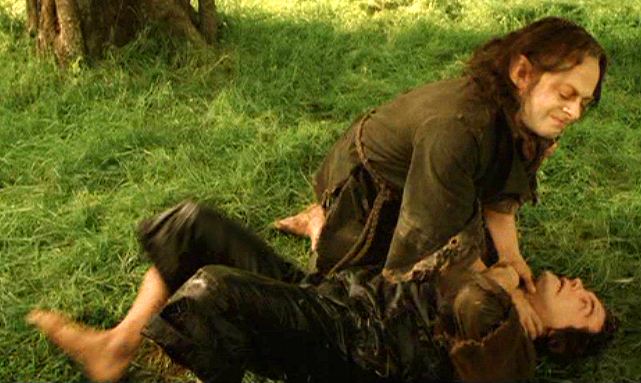 Other children stared with malevolence as we passed, as though their situation in life was our fault, or at least our inaction branded us as traitors to the system they believed in. Mzungus meant free things, we meant handouts and charity, but there was not an enduring sense of gratitude towards our charity. Instead there was an ugly expectant sense of entitlement, not something I am interested in perpetuating. The problem with this kind of charity is that it leads to all manner of abuse and is not sustainable. When we rich foreigners travel abroad, carelessly shedding money like dead skin, it has a highly detrimental effect in two major areas. The first is that it skews the impression of local people as to how much money we have and our ability to give it. This is why people are constantly trying to rip us off, coming and knocking on our gate asking us to sponsor them or just give them money straight up. This is why it is so hard to explain to people that we are not able to help everyone, that our money has very real finite limits. The second problem is that this can have a very detrimental effect on people working in development. Good development works to help people empower themselves; to make them self-sufficient so that when we are gone they will continue to prosper. Instead there is an expectation that we will just hand them the key to their future and they will not have to take responsibility for their own self-improvement. While it is true that we have access to many things that they do not, and need in order to get ahead, such as capital and education, in the end it is only their hard work and perseverance which will allow them to rise above their current situation and stay there. There is a very good reason why you see a lot more people begging in tourist centers. I do not mean to suggest that aid and charity are inherently bad, and that they are the source of all begging and development struggles, but they often do not help the way that we intend them to.
Other children stared with malevolence as we passed, as though their situation in life was our fault, or at least our inaction branded us as traitors to the system they believed in. Mzungus meant free things, we meant handouts and charity, but there was not an enduring sense of gratitude towards our charity. Instead there was an ugly expectant sense of entitlement, not something I am interested in perpetuating. The problem with this kind of charity is that it leads to all manner of abuse and is not sustainable. When we rich foreigners travel abroad, carelessly shedding money like dead skin, it has a highly detrimental effect in two major areas. The first is that it skews the impression of local people as to how much money we have and our ability to give it. This is why people are constantly trying to rip us off, coming and knocking on our gate asking us to sponsor them or just give them money straight up. This is why it is so hard to explain to people that we are not able to help everyone, that our money has very real finite limits. The second problem is that this can have a very detrimental effect on people working in development. Good development works to help people empower themselves; to make them self-sufficient so that when we are gone they will continue to prosper. Instead there is an expectation that we will just hand them the key to their future and they will not have to take responsibility for their own self-improvement. While it is true that we have access to many things that they do not, and need in order to get ahead, such as capital and education, in the end it is only their hard work and perseverance which will allow them to rise above their current situation and stay there. There is a very good reason why you see a lot more people begging in tourist centers. I do not mean to suggest that aid and charity are inherently bad, and that they are the source of all begging and development struggles, but they often do not help the way that we intend them to. It is experiences such as these, which has led me to take a slightly harsher stand on the issue of giving out money. I do not like being looked at like a cash dispensary and I have no wish to perpetuate a system that does not truly help the poor, and at the same time is creating systems by which foreigners are taken advantage of. Nothing is ever as cut and dry as we would like and I have made some few exceptions, however, I try hard to only ever give money which I know will be used to promote sustainable development, which will in turn help them to create more of their own money.
Eventually my tire was patched and my bike reassembled, loaded up and ready to go once more. I started out, praying that the patch would hold, and that today would be an issue free day for once. After all I only had about one hour of travel, and it didn’t seem like too much to ask for. Fortunately that day things were swinging my way and I arrived in Matema about an hour later, issue free. The road into Matema leads practically right to the gate of the Lutheran Hospital, which was my destination. My friend Lisa, who I met randomly on the ferry back from Zanzibar about a month earlier worked at the hospital there, and would be accompanying me down to Malawi the following day. My instructions were to call Lisa when I got to the hospital and she would come and collect me. I hopped off my bike and dug my phone out of my pocket, only to find that I had no network coverage at all.
There are several networks in Tanzania and many people have multiple phones and or SIM cards, which allow them to access each. If you are really intentional about it you can save quite a bit of money by calling people on the same network, avoiding cross network mark ups. When I first arrived in Tanzania I bought into this concept but quickly became annoyed with multiple phones and trying to remember who was on what network etc and simply fell to using a single number and phone. Of course the one that I had chosen, Vodacom, wasn’t helping me much now. Figuring that it was a small enough town that people would know one of the only Mzungus around I walked into the hospital courtyard and asked the first person I saw there. Fortunately he was a member of the hospital staff and even had her number in his phone. She arrived a few minutes later and showed me to my room.
What to say of Matema? It is a small and idyllic town on the northernmost shore of Lake Nyasa (Lake Malawi). A broad sandy beach leads to crystal clear warm waters and is flanked by lush green mountains on one side. There is a tourist campsite a little ways down the beach, that I suspect does not see a lot of business, as Matema is not exactly easily accessible, as I had discovered. The Lutheran presence was denoted by the hospital, a ‘beach resort,’ and a large church. The population is largely rural farmers with a few shop owners and other services sprinkled in, and of course the doctors. The German priests are forced to drink their beer in secret, if at all, as on the grounds of the Lutheran centre there is a no drinking policy. Even the resort does not sell any alcoholic beverages, not exactly a selling point to most travelers I know. All in all, however, Matema is a beautiful place, and worth the trek.


Lisa and I spent the day alternating between swimming in the lake and walking through the surrounding countryside/villages. It was nice to have a day free of stressing over my bike, and sweating in leather pants, and also nice to speak English without worrying about my being understood. Lisa is German, but speaks excellent English and there are few words or expressions that she does not understand. That night we ended up having dinner with the family of one of the hospital staff; him, his wife, 6-month-old twins and his 4-year-old daughter. I do not really recall how it started but at some point his daughter, whose name I forget, decided to start teaching us Swahili. She had a series of school exercise book with pictures of various items that were arranged to encourage basic math skills. 5 carrots plus 4 more gives 9, that sort of thing. She would point at an object and demand that we name it in Swahili, and then point at the next, which was invariably the same object and repeat. In the end you would end up saying something to the effect of,
Lisa and I spent the day alternating between swimming in the lake and walking through the surrounding countryside/villages. It was nice to have a day free of stressing over my bike, and sweating in leather pants, and also nice to speak English without worrying about my being understood. Lisa is German, but speaks excellent English and there are few words or expressions that she does not understand. That night we ended up having dinner with the family of one of the hospital staff; him, his wife, 6-month-old twins and his 4-year-old daughter. I do not really recall how it started but at some point his daughter, whose name I forget, decided to start teaching us Swahili. She had a series of school exercise book with pictures of various items that were arranged to encourage basic math skills. 5 carrots plus 4 more gives 9, that sort of thing. She would point at an object and demand that we name it in Swahili, and then point at the next, which was invariably the same object and repeat. In the end you would end up saying something to the effect of,
“Karroti, karroti, karroti, karroti, karroti, karroti, karroti, karroti, karroti, karroti, karroti.”
It became a bit of game to see how fast you could say them all. She is also clearly a believer in the old school method of teaching. ‘Spare the rod, spoil the child’ is clearly an adage which she believes in. Whenever I would make a mistake, she would rap me on the head with the pencil she was holding. It is amazing the things that I will accept and/or put up with for a cute little girl…
We only had a few hours for sleep that night before we had to get up and begin our trek into Malawi, as the only reliable Daladala to leave Matema in the morning is scheduled for around 5:30am. Thus, fed, educated, and chastised I was able to head to bed looking forward to crossing the border the following morning.

Glad to hear that you're a sucker but a smart one. Graham found the same lesson when he went to Zambia although he didn't tell me about anyone swearing at him. You've captured the problem in a few sentences, I hope you're time there will be fruitful in trying to provide something sustainable. xo
ReplyDelete